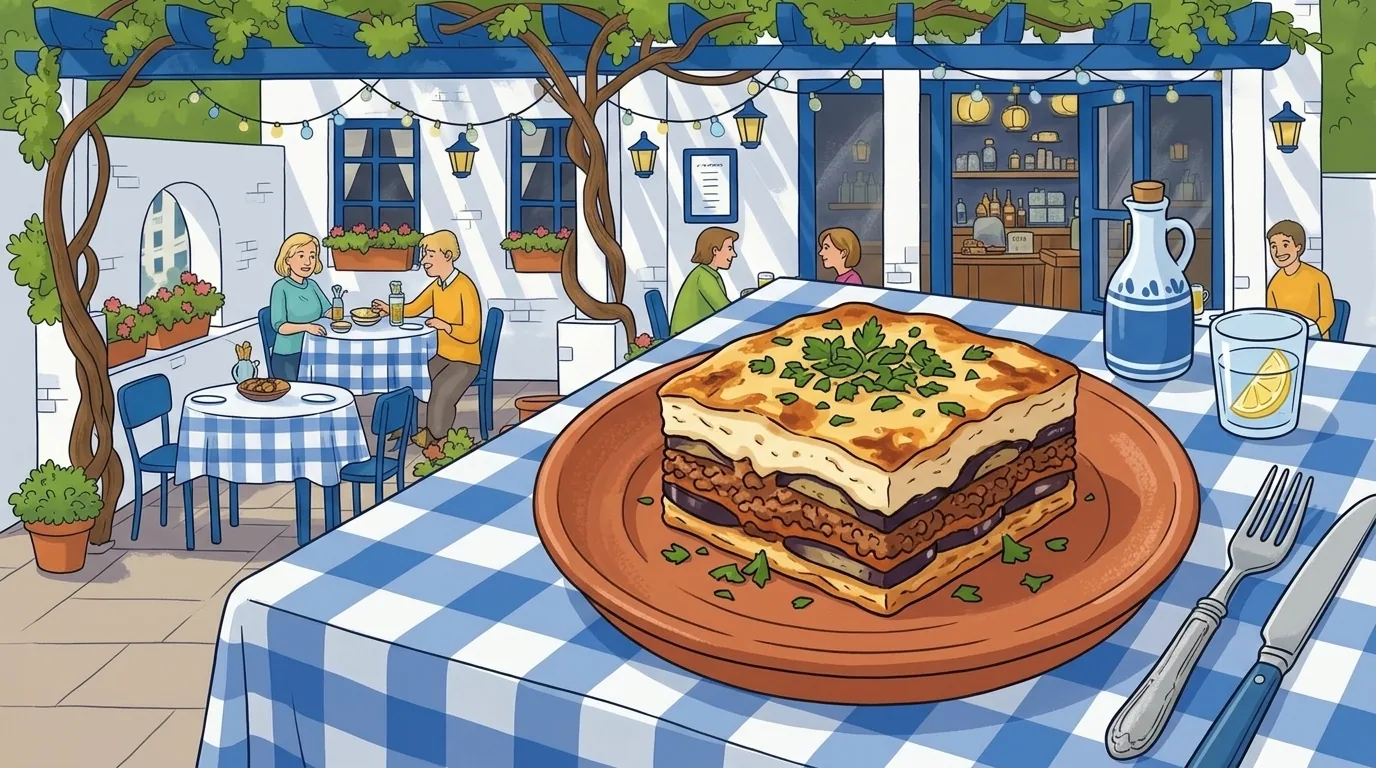
Note: This is not a house family recipe but the classic Greek-style moussaka, the way it is traditionally prepared in many regions of Greece. At Taverna Samos in Hamburg-Barmwisch we prepare it following the same fundamental principles.
Moussaka is one of Greece’s most famous dishes. The original 20th-century recipe is attributed to the Greek chef Nikolaos Tselementes. He combined Byzantine casserole tradition with French béchamel technique. Today there are regional variations across Greece.
At a glance
| Prep | 45 min |
| Bake time | 45 min |
| Resting | 20 min |
| Servings | 6 people |
| Difficulty | Medium |
What makes a good moussaka
A classic moussaka has three layers:
- Bottom: roasted eggplant
- Middle: spiced meat ragout with tomatoes and cinnamon
- Top: creamy béchamel with cheese
For the moussaka to succeed, every layer has to be perfect on its own. The most common mistakes:
- Eggplants too greasy (deep-fried instead of roasted)
- Ragout too dry or too liquid
- Lumpy béchamel
- Served straight from the oven, the layers fall apart
Ingredients (for 6 people)
Eggplant layer
- 4 large eggplants (about 1.2 kg)
- Salt for draining
- 4 tbsp olive oil
Meat ragout
- 500 g mixed minced meat (beef/pork)
- 2 medium onions, finely diced
- 3 garlic cloves, pressed
- 400 g peeled tomatoes (canned, chopped)
- 150 ml red wine
- 1 cinnamon stick
- 2 bay leaves
- 1 tsp dried oregano
- 2 tbsp olive oil
- Salt, pepper
Béchamel
- 750 ml whole milk
- 80 g butter
- 80 g flour
- 3 egg yolks
- 150 g Graviera cheese (alternative: Pecorino or Parmesan)
- Freshly grated nutmeg
- Salt, pepper
Preparation
1. Prepare the eggplants
Cut the eggplants into 8 mm thick slices, salt them on both sides and let them sit on a sieve for at least 30 minutes. This removes their bitterness and excess water.
Pat them dry thoroughly with kitchen paper and place on an oiled baking tray. Roast in the oven at 220 °C for about 20 minutes until golden brown, turning once.
Tip: Don’t deep-fry them in a pan. They soak up oil and make the moussaka greasy.
2. Meat ragout
Heat the olive oil in a wide pot. Sauté the onions and garlic until translucent, about 5 minutes. Add the minced meat and brown it gently over medium heat. It should take some color but not dry out.
Deglaze with the red wine and let it reduce. Add the tomatoes, cinnamon stick, bay leaves and oregano. Season with salt and pepper.
Simmer over low heat for at least 45 minutes until the sauce is rich and slightly thickened. Remove the cinnamon stick and bay leaves at the end.
3. Béchamel
Melt the butter in a pot. Stir in the flour and let it brown lightly for one minute while stirring constantly.
Gradually pour in the milk while whisking vigorously to avoid lumps. Cook over medium heat for 5 minutes until creamy.
Remove from heat, let it cool briefly, then stir in the egg yolks and 100 g of Graviera. Season with salt, pepper and nutmeg.
Tip: Add the egg yolks only when the béchamel is no longer boiling, otherwise they will curdle.
4. Layer and bake
Lightly oil a baking dish (about 30 × 25 cm) and layer:
- Bottom: eggplants
- Meat ragout spread evenly
- Béchamel poured over and smoothed
- Sprinkle the remaining 50 g of Graviera on top
Bake at 180 °C for about 45 minutes until golden brown.
5. Let it rest: the most important step
Many serve moussaka straight from the oven. This is a mistake. Let it rest for at least 20 minutes: it will set properly and the flavors will combine.
Greek saying: “Moussaka tastes even better on the second day”. The resting phase is the reason.
Serving suggestion
Classically, moussaka is served with a Greek farmer’s salad (Choriatiki) and homemade tzatziki. A dry red wine like Agiorgitiko or a rosé from Samos pairs perfectly.
Try it instead of cooking?
At Taverna Samos in Hamburg-Barmwisch, moussaka is a regular daily special. Give us a call to find out if it’s on today. If you’d rather skip the work:
- Reserve a table: Online reservation
- By phone: +49 40 6958519
- Address: Barmwisch 35, 22179 Hamburg
We look forward to your visit, in our cosy beer garden or indoors.
Καλή όρεξη!